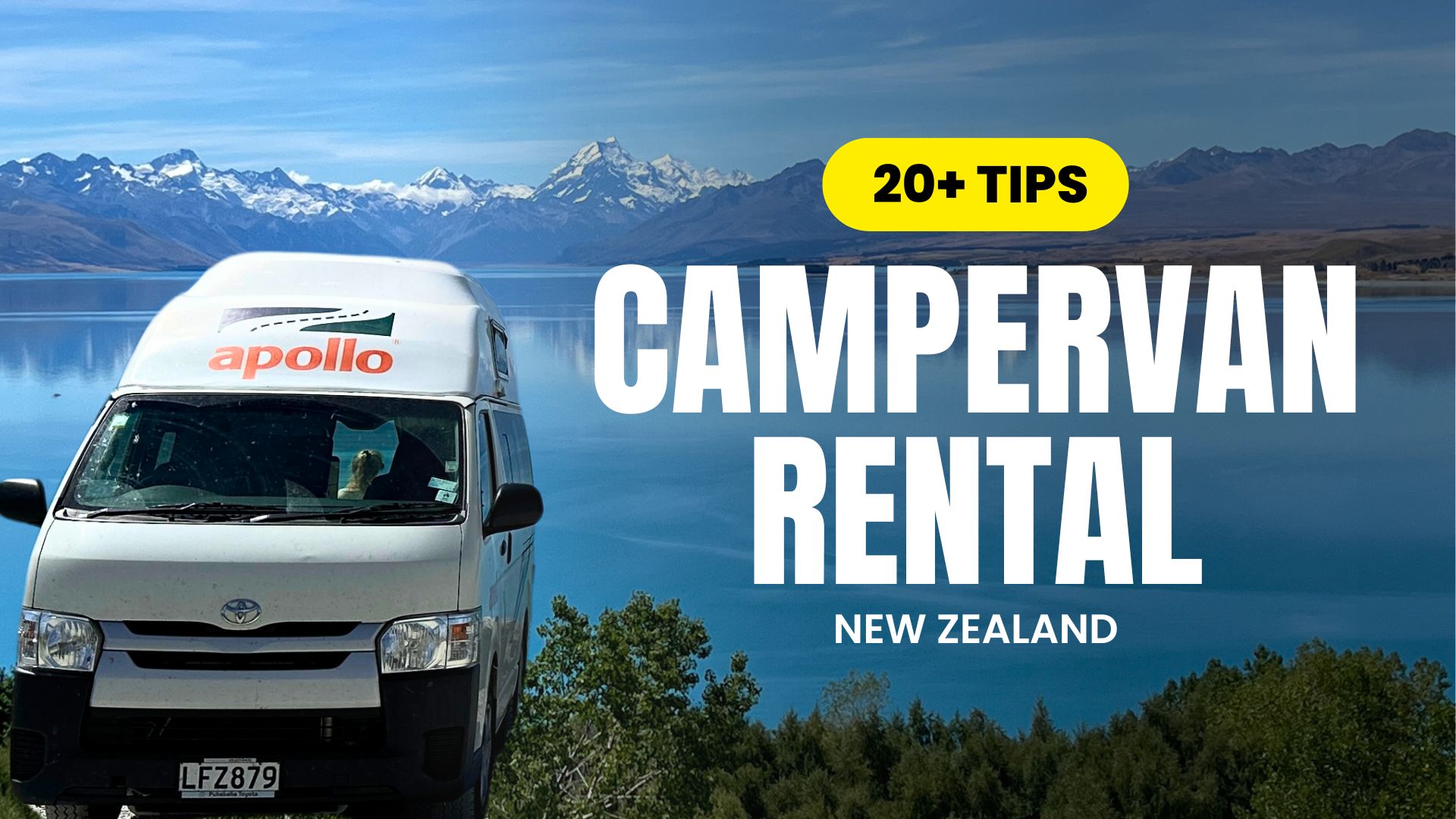
As first-time visitors to New Zealand, we learned a lot from our campervan road trip and want to share our best tips to help you prepare for your own adventure. Whether you’re renting a campervan for the first time or looking for insider advice, this guide covers everything you need to know.
If you missed our adventure, you can view our full itinerary, tips and places to stay in A Complete New Zealand 5 Weeks Road Trip Travel Itinerary, discovering both the north and the south island. Or watch our 5-part series available here on our YouTube channel.
Renting a Campervan in New Zealand
If you are still looking for a campervan to rent. We recommend checking out our partnership company via our affiliated link. If you book with them via us we get a small commission but you still pay the same competitive price. They often have promotions running with up to 30% off, so make sure you check out their prices first.

Compare campervan prices:
20+ Tips for Renting a Campervan in New Zealand
1. Full Insurance
You have probably seen the different insurance options when you have been looking at rental prices. Even if you drive carefully, unexpected things can happen, things like road debris, strong winds, or mechanical issues can cause damage – and repairs can be expensive. That’s why we highly recommend getting the full insurance.
Many rental companies offer different levels of coverage. The basic insurance usually comes with a high deductible, meaning you’ll have to cover a big portion of the cost if something goes wrong. Full insurance, on the other hand, reduces or removes the deductible and gives you peace of mind.
And trust us, you don’t want to take chances! On our trip, we experienced what seemed to be a water leakage. After four days, no water was coming out of the sink, even though we had filled up the tank as instructed. Instead, every time we added water, it started leaking from all sides of the van. Luckily, we had full insurance, and after calling the emergency number, the rental company sent us to a shop in the nearest city. They fixed the issue in just 30 minutes – without charging us a cent!
Also, check what’s included in the policy. Some insurances exclude things like windscreen damage or tire punctures, so always read what is included. We added both windscreen and tire puncture to our full insurance coverage. It might feel like an extra expense, but in the long run, it can save you a lot of money and stress!”

2. One-Way Fee & Extra Driver
When booking a camper van, one important thing to consider is whether you’ll be starting and ending your trip in the same city. We choose to pick up our van in Auckland and drop it off in Christchurch. While this is a great way to see both islands it often comes with a one-way fee. This fee can vary, and sometimes rental companies might waive the fee or even offer discounts to relocate their vehicles.
Another cost to consider is adding an extra driver. If you’re traveling with a partner or friend, it’s worth paying for an additional driver so you can take turns on long stretches.
It’s a good idea to clarify both of these costs before booking, so there are no surprises when picking up your camper van.

3. Unlimited Kilometres
New Zealand is bigger than it looks on a map, and you will likely end up driving much more than expected. Some rental companies offer limited kilometre packages, meaning you’ll have to pay extra if you go over a certain distance. These charges can add up quickly, especially if you’re exploring both the North and South Islands.
To avoid unexpected costs, we highly recommend choosing a camper van with unlimited kilometres. This way, you can enjoy your trip without constantly worrying about how far you’ve driven.
On our trip, we covered 5,856 kilometres over 5 weeks. Having unlimited kilometres gave us the freedom to take scenic detours, explore hidden spots, and change plans without stress. Unlimited kilometres can save you money in the long run and give you the freedom to explore at your own pace!

4. Fuel Policy (Diesel vs. Gasoline)
Camper vans in New Zealand typically run on either diesel or gasoline, and it’s important to know the difference before booking. Diesel is generally cheaper at the pump, but there’s a catch – New Zealand has a Road User Charges (RUC) tax for diesel vehicles, which you’ll need to pay separately when returning your van.
We had a gasoline vehicle and drove almost 6,000 kilometres during our trip. We ended up paying 942 USD for petrol. Had we rented a diesel vehicle, the fuel would have been a bit cheaper, but we would have also needed to pay around 250 USD for the RUC tax. So, it all depends on your travel plans and how much driving you expect to do.

5. Self-Contained Vehicle
When renting a camper van in New Zealand, you might come across the term ‘self-contained vehicle.’ This refers to a van that has a built-in toilet and/or greywater tank, making it fully equipped for independent camping. These vehicles allow you to camp in more remote and scenic spots, as you’re not required to stay at designated campsites.
If you’re planning to stay at so-called Freedom Camping areas (which are free to use), you’ll need to rent a self-contained vehicle. While it’s not mandatory for all types of camping, having one gives you more flexibility, especially if you’re venturing off the beaten path.
Self-contained vehicles are usually bigger in size, have more amenities, and are therefore more expensive. We opted for a van that was not self-contained, which was more budget-friendly for us.
If you decide to get a self-contained vehicle, make sure that it has the self-contained vehicle sticker when you pick up your van.


6. Check Vehicle Condition
Before you drive off, inspect the vehicle thoroughly and make sure to take photos and videos of both the inside and outside. This will help you document any existing damage or wear-and-tear. Most rental companies already do this, but it’s always a good idea to have your own record just in case.
It’s also helpful to check if all the equipment (like the kitchen, gas, or fridge) is in working condition. That way, if something goes wrong during your trip, you have proof of the condition when you first picked up the van.
It is also a good practice to always take a photo of the mileage and fuel level when you start your journey. Even if you have opted for unlimited kilometres, it is fun to know how far you have driven.

7. International Driver’s License
Before you pick up your camper van, make sure that your driver’s license is valid for use in New Zealand. Depending on where your license is from, you might need an International Driver’s Permit (IDP). In many cases, you can get one online, and it’s usually valid for a year.
In our case, we had our physical IDP with us, but it’s always a good idea to check with your rental company ahead of time to make sure what is accepted.

8. Left-Side Driving
New Zealand is one of the countries where people drive on the left side of the road, so it might take a bit of getting used to, especially if you’re from a country where driving is on the right. Be extra cautious when navigating intersections, roundabouts, or making turns, as your instincts might tell you to go the wrong way.
We had just come from a 4-week road trip in Australia, so we were already used to driving on the left side. But if it’s your first time, remember: look right, keep left! You get used to it quickly, and after a short time, it feels natural.


9. Long Distances
New Zealand’s roads offer some of the most scenic drives in the world, but many of them are long and winding, especially in more remote areas. You’ll likely be covering long distances, so it’s important to plan your driving times and avoid driving too late into the night.
On our 5-week road trip, we covered 5,856 kilometers, and while the views were breathtaking, some days felt longer than expected. We recommend planning your route with plenty of breaks, especially if you’re driving for several hours at a time.
One thing to note is that gas stations can be far apart on long stretches, especially in the South Island. For example, the drive from Te Anau to Milford Sound is about 2 hours and 120 km, with no gas stations along the way. We made sure to fill up in Te Anau before we left, and again when we returned. Always keep an eye on your fuel levels and plan refueling stops ahead of time, especially in more remote areas where the next station might be quite a distance away.

10. Road Restrictions & Tolls
In New Zealand, some rental companies impose road restrictions, meaning there are certain roads or areas you may not be allowed to drive your rental van on. This is typically due to road conditions or the size of the vehicle and driving on them with a regular camper van could result in fines or even damage to the vehicle.
Make sure to check with your rental company beforehand about any restricted areas, especially if you’re planning to venture off the beaten path. For us, this meant missing out on Crown Range Road, one of the most scenic drives in New Zealand, as well as a section of the north of Coromandel Peninsula. It was a bit sad, but it’s important to follow the rules to avoid fines. After all, it’s better to be safe than sorry and to keep your trip stress-free!
Be aware that New Zealand has a few roads with tolls, they are all located in the North island. To avoid toll roads, you can use the setting ‘avoid tolls’ on Google Maps.


11. Single-Lane Bridges
New Zealand has many single-lane bridges, especially on the South Island. This is on the list because it was the first time we encountered this, and there are a lot of them, especially on the West Coast of the South island and near Mount Cook. Before crossing, slow down and watch for the signs to see which direction has the right to go first. It is not always that the view is clear and some bridges can be quite long, so be cautious.

12. Weather Conditions
New Zealand’s roads are often steep, narrow, and full of sharp curves, especially in the mountains and coastal areas. When it rains, roads can get very slippery, making it even more dangerous. We witnessed a terrible accident on a winding road where a car had flipped upside down in a curve. It even had a baby seat inside, which was a chilling reminder to always drive cautiously.
Fog is also common, and the wind can be very strong, which we experienced a lot along the East Coast of the South island and during the inland drive to Mount Cook.
On scenic roads, also expect cars and campervans to stop unexpectedly and park along the road as people pull over to take photos – so stay alert and keep a safe distance! And only park in designated parking and viewing areas.

13. Emergency Number
If something happens to your camper van on the road, knowing who to call can save you a lot of stress. Rental companies usually provide an emergency contact number for breakdowns or repairs. If they don’t mention it when you pick up the van, make sure to ask!
We had an issue with what seemed to be a water leakage – after four days, our sink stopped working, and every time we filled up the water tank, it just leaked straight out from the bottom of the van. We called the emergency number, and they directed us to a repair shop in the nearest city. They fixed the problem in just 30 minutes, and it didn’t cost us anything. It wasn’t our fault that it was broken, but thanks to the full insurance there were no questions asked!

14. New Zealand Biosecurity Rules
Not related to the camper van rental or the road trip, but be aware that New Zealand has very strict biosecurity rules and you will need to declare if you are carrying any items that have been used for outdoor activities. This includes things like hiking boots and hiking poles. You cannot have dirty or muddy shoes. When we arrived we declared that we had hiking shoes in our backpacks and the customs officers asked to see them. As we knew about this, we had cleaned the shoes thoroughly before our flight. You might have to pay a fine otherwise.

15. Plan Your Route
Planning your route ahead of time is important to make sure you hit the spots you want to visit. We covered 5,856 kilometers in 5 weeks, and even though we had some flexibility in our plans, we had to adjust our route several times. If you only have a couple of weeks, you will probably have to pick if you want to go to the north or the south island.
Keep in mind that some distances are long, and many popular destinations are far inland or on the coast. For example, the drive to Milford Sound from Te Anau is about 2 hours one way, and you’ll need to drive back the same way. Mount Cook is also at the end of a dead-end road, so be sure to account for these detours when planning your route. We traveled during peak season but only booked campsites a day or two in advance, and that worked out perfectly for us.
Some popular destinations, especially during peak season, require advanced booking, such as certain campsites and activities. One of the trickiest parts of planning was making sure we could make it to the inter-island ferry on time, which should definitely be booked well in advance if you’re traveling during high season.

16. Inter-Island Ferry
When traveling between the North and South Islands of New Zealand, you’ll need to take the inter-island ferry. The two main ferry companies operating between the Islands are Interislander and Bluebridge. The ferries depart several times daily from Wellington on the North Island and arrive at Picton on the South Island.
We traveled during peak season—Christmas and New Year – so we booked our ferry 3 months in advance, knowing how busy it could get. However, despite booking early, we thought, our only option available was the overnight ferry, and unfortunately, all sleeping cabins were already fully booked. This meant that we had to make the journey without a cabin, which wasn’t ideal for a 3.5-hour trip. While there are seats and even a movie theatre on board, many passengers ended up sleeping on the floor, we were lucky to get two seats in the movie theatre so we could get a couple of hours of sleep.
It’s a good reminder to check availability well in advance, as the ferries can fill up quickly, especially during peak season.


17. Laundry
Laundry might not be something you immediately think about when preparing for a road trip, but after a week or two on the road, you’ll likely want to refresh your clothes. Many campsites in New Zealand offer laundry facilities, often with washers and dryers, and the cost is usually around 4-6 NZD per load.
In general, you can pay by card in all of New Zealand, even in smaller stores, but make sure that you get some cash and keep the coins as many campsites still operate coin machines, but in some places you can pay with debit card. We also spotted a few laundry facilities in towns and cities if you are not staying in campsites.

18. Sandflies
Sandflies are a big issue in New Zealand, especially in the South Island. They’re tiny but can be really irritating, leaving itchy bites, worse than mosquito bites. We quickly learned that sandfly-specific repellent and even sandfly candles are a must. In some areas, like the West Coast in the South island, we couldn’t even sit outside in the evenings because of them. We had heard about the sandflies from other travellers but didn’t think it was going to be that bad, but they completely destroyed Emmelie’s legs. Avoid this and make sure to bring sandfly repellent, as it works much better than regular insect spray. You can also buy it at supermarkets or outdoor stores in New Zealand.


19. Groceries
New Zealand has a variety of supermarkets, such as Countdown, New World, and Pak’nSave, where you can stock up on food for your road trip. While supermarkets are fairly easy to find in cities, you might need to plan ahead when traveling to more remote areas, as grocery stores can be limited. For example the closest grocery store to Arthur’s Pass is 1.5 hours away. We also found that food prices are higher than in many other countries. It’s a good idea to buy in bulk when you’re in bigger cities and stock up with what you need to save some money.

20. Pay It Forward
When you return your camper van, consider paying it forward by leaving behind any items you won’t use or can’t keep. Many drop-off locations have donation boxes where you can leave things like extra food, camping gear, or supplies. These small acts of kindness help other travellers who might need them. It’s a simple way to help others and leave a little positive impact on someone else’s adventure. Equally, when you arrive and pick up your van, have a look in the donation box to see if there is anything you need.
21. Local SIM Card
When traveling in New Zealand, buying a local SIM card is a good idea for navigation and staying connected. Avoid purchasing SIM cards at the airport, as they tend to be more expensive. Instead, head to official stores or supermarkets, and top up online for better rates.
We used both One NZ which cost 40 USD for 40 GB. And 2degrees, which has unlimited data for 30 days for $54 USD. We found that their coverage was similar, but note that coverage is limited in remote areas. Remember that most campsites don’t have wifi so you rely on data for social media and other entertainment too.

How much it cost to rent a camper van in New Zealand
New Zealand is one of the most expensive countries we’ve visited, not just for SIM cards and groceries, but for many other things as well. To help you prepare for your road trip, we are sharing below how much it cost us to complete this 5 weeks trip:
Campervan: 7,100 USD (This price is for 5 weeks including the full insurance that we do recommend taking so you don’t have to worry if you get hit by a small rock in the windscreen or a flat tire, the price also changes depending on the season and how far in advance you booked). It was also during high season so expect higher rates during this period.
Petrol: 942 USD (Unleaded). Note that New Zealand has a diesel tax charge if you get a diesel van.
Campsites: 1,150 USD (All the campsites were powered but if you feel that could handle few days without electricity, perhaps you could save a bit more on this).
Groceries: 1,931 USD (This includes all groceries and also SIM cards and clothes).
Food & Beverage: 858 USD (This includes the cost of eating out – yes we did not cook every day).
Activities: 1,006 USD (Festival tickets, Milford sound, Hobbiton, etc.)
Total: 12,987 USD.
Leave a Reply