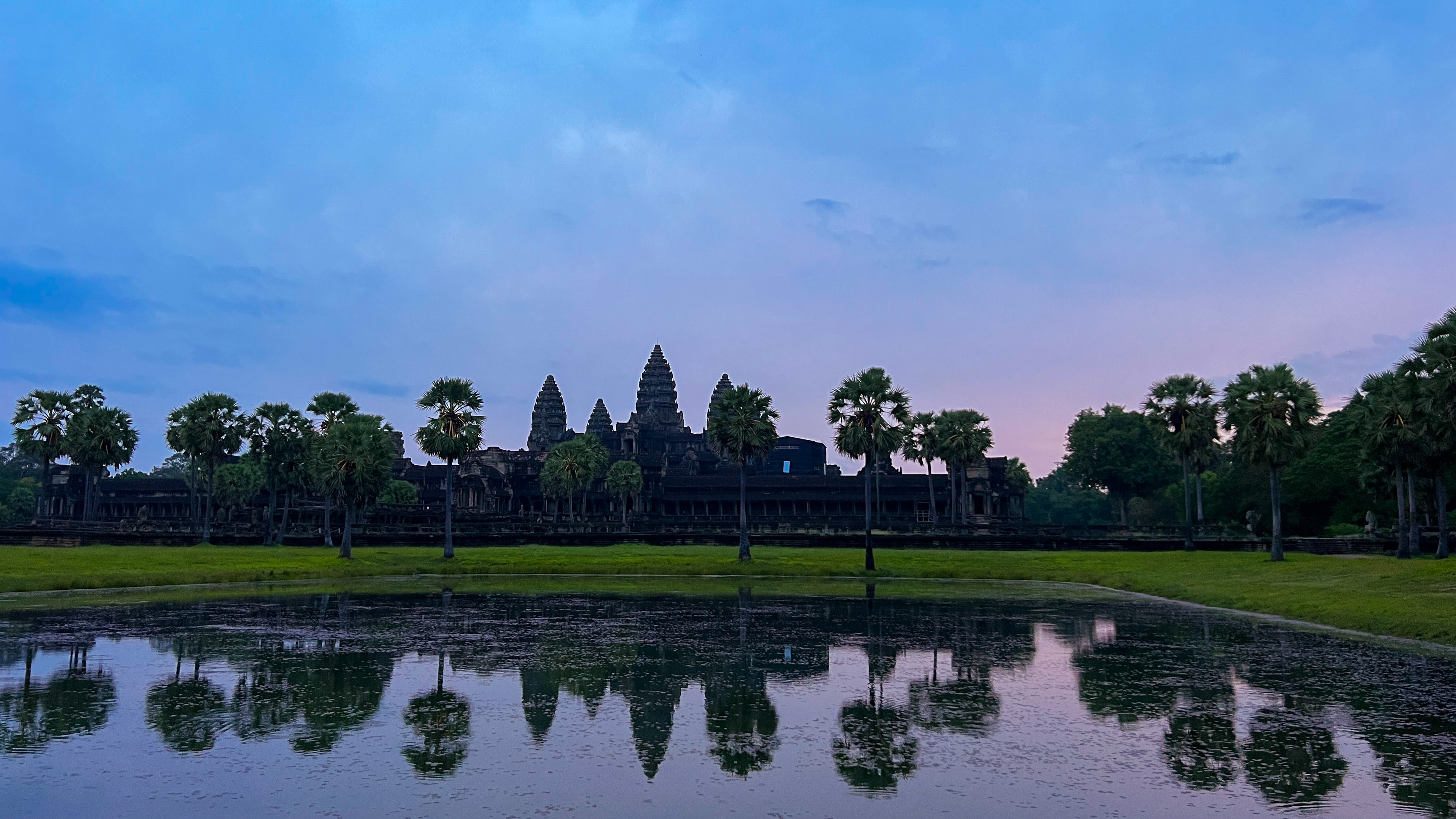
Have just one day to explore Angkor Wat? No issue! This Angkor Wat one-day itinerary was put together to help you get the most out of the little time you have at this spectacular UNESCO World Heritage site.
It is impossible to see all of the more than 1000 temples within a 400 square kilometre area in a single day or even a single week. But using this itinerary as a guide will allow you to schedule your time wisely and explore the attractions that most people consider to be the highlights of Angkor Wat.
Map of Angkor Wat

Hopefully, this map and information will help you understand how the major area of the Angkor Wat Archaeological Park is laid up. This should make it easier for you to create the ideal Angkor Wat 1-Day Itinerary for yourself.
The two primary circuits (or “loops”) are the great loop (shown in green), also known as the grand circuit, and the tiny loop (shown in red), also known as the small circuit. The Angkor Wat and Angkor Thom temples are on both loops before diverging on opposite paths.
These routes will actually be combined in our one-day itinerary for Angkor Wat to give you what we think are the absolute highlights of each.
Small Loop
The small loop consists of Angkor Wat, Angkor Thom, Ta Keo, Ta Prohm, Banteay Kdei, and Prasat Kravan.
Big Loop
The big loop includes Angkor Wat, Angkor Thom, Preah Khan, Neak Pean, Ta Som, East Mebon and Pre Rup.
Angkor Wat 1 Day Itinerary
Without going to Angkor Wat, no trip to Cambodia is complete. It is the ultimate fantasy location to check off your travel bucket list. You may still see some of the most important temples in Angkor Wat even if you only have one day to do so.
We believe the suggested one-day schedule below is the finest course. Timing, avoiding crowds, and maximising what you can enjoyably see have all been taken into account.
STOP #1: ANGKOR WAT TEMPLE AT SUNRISE
Within the Angkor complex, Angkor Wat is the biggest and most recognisable temple. It was originally a Hindu temple devoted to the god Vishnu that took three decades to construct in the early 12th century. However, it was progressively changed into a Buddhist temple by the end of the 12th century.
In particular, if you want to take the greatest pictures of Angkor Wat, it is worthwhile to arrive early to ensure your location for sunrise at the temple, which opens at 5am. We arrived at the gate first at 5am, narrowly beating out a sizable crowd, and were able to secure a front-row spot along the water’s edge for an unhindered picture. There are two ponds with reflections of Angkor Wat in them, one to the left and one to the right. However, the one on the left was almost completely dried up when we visited in end of May.
Arriving any time after 5am will give you plenty of time to wander as the sun rises if you are there more for the experience than the photo. The temple itself isn’t that impressive in our opinion, but nonetheless a must-visit when you are here. You can climb up the tower in the middle of the temple for amazing views over the grounds.
Take your time to explore Angkor Wat or to get breakfast since the next temple you’ll see doesn’t open until 7:30am. If breakfast is provided at your accommodation, you might be able to order breakfast to go, although there are also many food vendors throughout Angkor. If you are having breakfast at Angkor Wat, we recommend going to the facilities outside of the temple, they have a bigger variety and are a bit cheaper than those inside.

STOP #2: Angkor Thom (Bayon)
This was one of our favourite temples. Bayon temple closes at 5:30pm and you’ll likely want at least an hour to explore, so make sure you arrive with plenty of time. It lies within the heart of Angkor Thom, the old capital city, and is often referred to as the “face temple” due to the multitude of smiling faces carved into it.
Unlike some of the other temples, Bayon is one that is best experienced up close, where you can be immersed amongst the 216 mysterious faces.

STOP #3: Preah Khan
One of Angkor Wat’s major temple complexes, Preah Khan formerly housed some 100,000 people and served as a city, temple, and Buddhist university.
With distinct portions of the old ruins being encircled by the jungle and trees, it has a similar appearance as Ta Prohm. Its seemingly endless tunnels give you the impression that you are inside of some sort of labyrinth, nevertheless. You will walk through the temple and come out on the other side.

STOP #4: Neak Pean
Since Neak Pean was so unimpressive, we would advise bypassing it if you’re pressed for time. If you do decide to visit it, be prepared for a very hot walk since the wooden bridge that leads to it is completely exposed.
Give Neak Pean a look if you are moving quickly and want to see everything. This would be the one to skip if you’d like to save energy and possibly go back in front of the audience.

STOP #5: Ta Som
Ta Som is a small 12th-century Buddhist temple. The strangler fig tree that engulfs its eastern gate is its most conspicuous feature, presenting a comparable photo opportunity to the more popular shot at Ta Prohm. Because it is sometimes overlooked by other travellers, it is not rare to have the spot to yourself, which it was in our case.

STOP #6: Pre Rup
One of our favourite temples was Pre Rup. It is one of the ancient temples, having been dedicated to the Hindu Goddess Shiva in 961. The ascent may make you sweat, but the views from the summit are well worth it! You can embark on the difficult path to reach the top or take the wooden stairs on the east side.

STOP #7: Ta Prohm
Ta Prohm is the second-most visited temple, and also one of our favourite, so you will most likely not be alone here. Make sure to take your time and save energy to walk through this rather large temple. It is easy to get lost here.
Ta Prohm is also known as the “Tomb Raider Temple” because it was made famous by the blockbuster movie starring Angelina Jolie. It’s tucked away in the jungle and famous for the peculiar tree roots that grow over the temple ruins.

BONUS SUNSET AT ANGKOR WAT
A little something extra for you! The one-day pass is only valid on the day of purchase, although tickets purchased after 5 p.m. are valid the next day. Furthermore, if you purchase your ticket after 5 p.m., you can enter Angkor Wat for sunset that evening. Be advised that there will be long waits at the ticket office for the one-day passes.

Where to Stay In Siem Reap
What we really like about this specific Mad Monkey is the nice vibe in the hostel, and they also do so many activities everyday (Food tour – Angkor wat – Typical Khmer food – Pub Crawls) is a nice place if you feel like socialising and making new friends.
LOCATION: Located in the center of Siem Reap, a 5-minute walk from Pub Street and 4.3 mi from Angkor Temple.
Price: 21 USD (Private Room).

How to get to Siem Reap
We go here by bus from Sihanoukville, where we had spent the last week in Koh Rong Islands. We took a 12 hours overnight sleeper bus which cost around $20 per person. We opted for the Luxury bus ticket as it provided more privacy with curtains.

From Siem Reap you can also go directly to Laos and the 4000 islands / Si Phan Don. The tickets we got included minivan transfer to and through the border plus the boat ticket to the island.
Conclusion
While it will be a long and exhausting day, it is entirely possible to cover a lot of ground in just one day at Angkor Wat! Of course, a 1 Day Angkor Wat Itinerary would never let you to visit all of the temples. However, it will provide you with an excellent overview of this magnificent archaeological site.
Leave a Reply